Best Sliding Doors from China for Global Buyers?

Choosing the best sliding doors from China requires more than comparing catalog prices. Global buyers need to examine design quality, material consistency, manufacturing experience, and supplier reliability. A polished product image is not enough. The real evidence appears in hardware samples, factory records, test reports, and customer references.

China offers many sliding door options for homes, offices, hotels, and commercial projects. Buyers may find aluminum-framed glass doors, thermal-break systems, wooden designs, and large-panel configurations. Each option serves a different climate and building requirement. Coastal projects may need stronger corrosion resistance. Cold regions may require better insulation and sealed glazing. Busy entrances need durable rollers, locks, and tracks. Small details matter.

A practical evaluation should begin with the project’s dimensions, opening frequency, safety expectations, and installation conditions. Ask suppliers for profile specifications, glass details, surface-treatment information, packaging methods, and quality-control procedures. Independent inspection can reveal scratches, uneven gaps, weak corners, or poorly adjusted rollers before shipment. It is not glamorous work.

Still, supplier claims deserve careful review. Certifications may vary by market, product type, and testing scope. Buyers should confirm whether documents apply to the exact model being purchased. Communication also matters. Clear drawings, production updates, and replacement-part support often predict a smoother project. No supplier is perfect. Mistakes happen, and some specifications may need revision. The strongest partners acknowledge problems quickly and provide traceable solutions. This guide explores how global buyers can compare Chinese sliding doors with greater confidence, practical judgment, and attention to long-term performance.
Best Sliding Doors from China for Global Buyers?

What Defines the Best Chinese Sliding Door: U-Value, Air Leakage and Load Ratings

For global buyers, the best sliding doors from China are not defined by appearance alone. U-Value, air leakage, and load ratings reveal how the door performs in real buildings. The U.S. Department of Energy estimates that windows and doors can cause 25–30% of residential heating and cooling energy use. A lower U-Value generally means better insulation. Yet, this figure can change with glass type, frame material, spacer design, and installation quality.

Air leakage deserves close attention. NFRC 400 measures leakage at a standard pressure, reported in cubic feet per minute per square foot. A tight sliding door should have tested results, not vague claims. Check the interlocking stile, brush seals, drainage paths, and corner joints. Small gaps become obvious on a windy floor. Sometimes, the frame looks excellent, but the seal is poorly fitted. That mistake happens.

Load ratings confirm structural reliability under wind pressure. ASTM E330 and AAMA/WDMA/CSA 101 testing can show whether the assembly resists pressure and permanent deformation. Buyers should request the tested design pressure, span, glass thickness, and sample size. EN 12210 classifications may also help European projects compare wind resistance. One rating cannot suit every climate. Coastal towers, inland homes, and exposed commercial sites need different specifications. A factory report is useful, but independent verification remains wiser.
Best Sliding Doors from China for Global Buyers

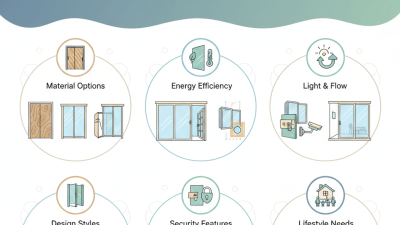
Performance comparison of representative sliding-door specification levels using whole-door U-value, air leakage at 75 Pa, and design wind-load resistance.

Lower U-value and lower air leakage indicate better thermal and weather performance, while a higher design wind-load rating indicates greater structural resistance. Actual results should be confirmed through accredited testing for the selected door size, glass package, hardware, and installation condition.

Aluminum, uPVC, Wood and Thermal-Break Profiles: Material Data Compared

Choosing sliding doors from China requires more than comparing frame prices. Material performance matters. Aluminum offers high strength and slim sightlines, but its thermal conductivity can exceed 160 W/m·K. Without a thermal break, indoor heat escapes quickly. uPVC is near 0.17 W/m·K, while many softwoods range from 0.12 to 0.18 W/m·K, according to reference values in EN ISO 10456.

Thermal-break aluminum uses polyamide separators to reduce heat transfer through the frame. Certified systems can achieve low Uw values, but glass, spacers, seals, and installation also control the result. A profile alone cannot promise energy efficiency. The 2023 UNEP Global Status Report states that buildings and construction created 37% of global energy and process-related CO2 emissions in 2022. That makes verified thermal data commercially important, not decorative.

Embodied carbon deserves attention too. The International Aluminium Institute reports an average primary aluminum emissions intensity of about 15.1 tonnes of CO2e per tonne in 2021. Recycled content can reduce this figure, but suppliers should provide traceable calculations. Wood may store biogenic carbon, yet moisture protection and certified sourcing need careful review. uPVC can be cost-effective and stable, although recycling pathways differ by region. I would request EN 14351-1 test results, ISO 14025 environmental declarations, air-tightness data, and full-size sample testing. Small laboratory samples can look excellent. Real buildings are less forgiving.

Best Sliding Doors from China for Global Buyers? - Aluminum, uPVC, Wood and Thermal-Break Profiles: Material Data Compared

Typical indicative values for residential and light-commercial sliding-door systems. Actual performance depends on profile geometry, glazing, seals, hardware, installation and applicable testing standards.
Performance Dimension Standard Aluminum Thermal-Break Aluminum uPVC Wood
Typical profile material Aluminum alloy, commonly 6063-T5/T6 for architectural profiles Aluminum alloy with a polyamide thermal barrier, commonly 18–34 mm wide Unplasticized polyvinyl chloride with steel or galvanized reinforcement where required Engineered or solid timber, often softwood, hardwood or laminated wood
Approximate material thermal conductivity 160–205 W/m·K for aluminum alloy 160–205 W/m·K for aluminum; the polyamide barrier is typically about 0.25–0.35 W/m·K Approximately 0.17–0.25 W/m·K Approximately 0.12–0.18 W/m·K, depending on species and moisture content
Indicative whole-door U-value Approximately 2.5–5.7 W/m²·K with insulated glazing; usually the weakest thermal option Approximately 1.4–2.5 W/m²·K with low-e double glazing; high-performance systems may achieve lower values Approximately 1.2–2.0 W/m²·K with multi-chamber profiles and insulated glazing Approximately 1.0–1.8 W/m²·K with suitable timber sections and insulated glazing
Thermal-bridging risk High unless the design includes a thermal break or other continuous insulation Low to moderate when the barrier, corners and glass edge are correctly designed Low; steel reinforcement and metal hardware can create localized bridges Low; joints, hardware and moisture-related defects require careful detailing
Typical frame and sash durability Very high; resistant to rot and insect attack Very high; resistant to rot and insect attack High when protected from excessive heat, impact and ultraviolet exposure High when properly coated, drained and maintained; moisture is the main risk
Maintenance requirement Low; clean surfaces, inspect seals and lubricate rollers periodically Low; inspect thermal-break joints, seals, drainage and hardware Low; clean surfaces and replace worn seals or rollers as needed Moderate to high; repainting or recoating may be required every few years
Structural strength and maximum panel potential Excellent strength-to-weight ratio; suitable for large panels and narrow sightlines Excellent; suitable for large panels when profile depth, glass weight and rollers are correctly engineered Good for standard residential sizes; large panels require reinforced profiles and suitable hardware Good; section size and moisture stability become more important as panel dimensions increase
Weather resistance High with correctly designed drainage, gaskets and surface coating High; performance depends on drainage paths, seals and installation quality Good to high; expansion, drainage and ultraviolet stability should be verified Good only with robust coating, drainage and regular maintenance
Acoustic performance potential Approximately 28–40 dB for typical insulated-glass configurations Approximately 30–42 dB with suitable laminated or acoustic glazing Approximately 28–40 dB depending mainly on glazing and gasket compression Approximately 28–40 dB depending on timber section, seals and glazing
Fire and smoke considerations Non-combustible metal frame, but complete door classification depends on the tested assembly Non-combustible aluminum frame with polymer thermal barrier; complete assembly testing is required Combustible polymer; fire performance depends on formulation and complete tested assembly Combustible material; charring behavior and complete assembly testing determine classification
Sustainability and end-of-life Highly recyclable; recycled content can reduce embodied carbon Aluminum is highly recyclable, but the bonded polyamide barrier complicates separation Recyclable through appropriate PVC recovery systems; additives and reinforcement affect recycling Renewable material when responsibly sourced; repair and reuse are generally practical
Best fit for global buyers Budget-conscious projects, mild climates, wide openings and slim contemporary sightlines Energy-efficient homes, premium glazing, large openings and mixed or cold climates Cost-sensitive residential projects seeking low maintenance and good thermal insulation Projects prioritizing natural appearance, repairability and renewable material content
Buyer verification note: Request project-specific test reports for whole-door U-value, air permeability, watertightness, wind resistance, acoustic rating and operating-cycle durability. Values should be compared using the same test method, door size, glazing specification and installation conditions.

Glass Selection by U-Value, SHGC, Visible Transmittance and Safety Standards

Best Sliding Doors from China for Global Buyers?

Glass selection should begin with climate, not appearance. The U.S. Department of Energy reports that windows can cause 25–30% of residential heating and cooling energy use. Lower U-values reduce heat transfer, but units must be compared consistently. Some reports use W/m²·K, while others use Btu/h·ft²·°F. Ask whether the value covers center glass, whole door, or the complete frame. A low number may look impressive.

SHGC controls solar heat entering through the glass. In hot regions, lower SHGC can reduce cooling demand. In cold climates, a moderate value may capture useful winter warmth. Visible transmittance, or VT, measures daylight transmission. The National Fenestration Rating Council explains that higher VT generally provides brighter interiors, but glare can increase near large south-facing openings. Clear, low-e, tinted, and laminated glass produce different balances. The best specification is rarely the darkest glass.

Safety requires more than a thickness statement. Tempered glass should comply with standards such as ANSI Z97.1 or EN 12150, while laminated glass can retain fragments after breakage. For larger panels, request impact testing, heat-soak information, and complete-door performance data. Check the laboratory report, test date, sample size, and hardware configuration. Missing details matter. A 2023 international building-energy review also emphasizes that installation quality can undermine rated performance. Even excellent glass can fail expectations when seals, drainage, or alignment are poor. This is the uncomfortable part: buyers often compare numbers before checking the test method.

Factory Verification Through AQL Levels, ISO 9001, CE and ASTM Compliance

Global buyers often ask for the best sliding doors from China. The better question is whether the factory can prove repeatable control.

Start with sampling. Use ISO 2859-1 and document the inspection level, lot size, sample count, and acceptance number. AQL 1.5 may suit visible finish defects, but it is not a universal rule. Safety-critical failures need separate controls. Check profiles, glass, rollers, locks, seals, packaging, and opening force against approved drawings. Photographs and signed reports make results auditable. An AQL pass does not prove every door is perfect.

The ISO Survey 2023 recorded 1,265,216 ISO 9001 certificates worldwide. This scale shows the system’s importance, not automatic product quality. Verify the certificate scope, factory address, expiry date, and audit status. CE is not a quality badge. For European sales, identify the applicable harmonized standard, prepare the correct Declaration of Performance or Conformity, and retain test evidence. The marking must match the actual door configuration. For United States projects, map contract requirements to applicable ASTM methods, including E1886 and E1996 where impact exposure applies. ASTM methods support testing; they do not replace engineering judgment.

UNEP’s 2023 buildings report attributes 34% of global energy demand to buildings. Request U-values, air-leakage results, glass specifications, and hardware-cycle evidence. Thermal claims need test conditions. One weakness remains: factories may show excellent documents but inconsistent labeling or revision control. Recheck a production batch before shipment. That step is easy to skip.

Global Buying Metrics: MOQ, Lead Time, Incoterms and Installed Cost

Best Sliding Doors from China for Global Buyers?

For global buyers, the lowest unit price rarely determines the best sliding door. A practical comparison starts with MOQ, lead time, Incoterms, and installed cost. In procurement practice, many factories quote MOQs from 10 to 50 sets. Standard aluminum doors may ship within 25–45 days, while custom colors, laminated glass, or thermal breaks can add two weeks. These ranges need written confirmation.

UNCTAD’s Review of Maritime Transport 2023 states that more than 80% of global merchandise trade moves by sea. Freight delays therefore affect real project costs. Under FOB, the buyer controls ocean freight after loading. CIF looks simpler, but destination charges remain uncertain. DAP can improve delivery visibility, although import duties usually remain the buyer’s responsibility. The World Bank Logistics Performance Index 2023 also shows that border procedures and shipment timeliness can vary significantly between markets.

Tips: Request a door schedule, packing photos, test reports, and a sample before approving bulk production. Compare installed cost, not just factory price. A realistic calculation includes the door, packaging, inland transport, ocean freight, insurance, duties, local delivery, hardware, and labor.

For example, a 420-dollar door can exceed 850 dollars after installation in a distant market. That estimate may still be wrong. Labor rates and site conditions change quickly. I would keep a 10–15% contingency and verify every charge in the proforma invoice.